


Upptäck Mímis

AI-agent för smartare e-handel
Published 2026-05-11
The rules of selling in ChatGPT are being rewritten
– What the OpenAI and Amazon partnership means for your e-commerce
In ten days in February and March 2026, the rules of AI commerce were rewritten. Amazon invested 50 billion dollars in OpenAI. OpenAI shut down its direct purchase feature in ChatGPT. Amazon launched Shop Direct. Three separate events, ten days, and a completely new picture of how ChatGPT works as a commerce channel.
And it probably won’t be the last time. The infrastructure behind AI commerce is changing at a pace that’s hard to keep up with, and if you don’t, you risk making strategic decisions based on a picture that is already out of date. This article breaks down what actually happened, why it happened, and what it is likely to mean going forward.
In short:
Over ten days in February and March 2026, the conditions for selling through ChatGPT changed fundamentally. Amazon invested 50 billion dollars in OpenAI. OpenAI shut down Instant Checkout after conversion data showed that direct purchases in the chat interface performed three times worse than on the merchant’s own site. At the same time, Amazon launched Shop Direct for its own AI surfaces. ChatGPT’s role is shifting from transaction platform to discovery channel. Microsoft’s exclusivity agreement with OpenAI is now under legal review. For e-commerce businesses, the priority is clear: build visibility in AI search now, and hold off on your transaction strategy.
What happened, and in what order?
Three events in ten days changed the conditions for how ChatGPT works as a commerce channel.
27 February 2026: Amazon and OpenAI announce a strategic partnership. Amazon invests up to 50 billion dollars in OpenAI and, in return, gets a central role in OpenAI’s cloud infrastructure.
4 March 2026: OpenAI confirms that Instant Checkout is being shut down. The feature, which since September 2025 had made it possible to buy products directly inside ChatGPT, is replaced by a model where merchants create their own apps in the platform and the purchase happens on the merchant’s own site.
11 March 2026: Amazon launches Shop Direct, a system that lets external merchants sync product data, pricing and stock status with Amazon’s AI infrastructure and reach customers through Amazon’s own AI services, Rufus and Buy for Me.
These three events are separate decisions, but they point in the same direction: ChatGPT’s role in the buying journey is changing, and Amazon’s infrastructure is taking a more central position in the AI-driven commerce landscape.
Why did OpenAI shut down Instant Checkout, and why does it matter?
Instant Checkout had been live for less than six months when OpenAI chose to shut it down. The decision coincided with the Amazon partnership, but it was driven by something else: real users simply weren’t buying in ChatGPT’s chat interface.
Walmart gave us the clearest data point. Daniel Danker, Walmart’s EVP of Product and Design, confirmed to WIRED on 18 March 2026 that the conversion rate for purchases made directly in ChatGPT was three times lower than for transactions where the user clicked through to Walmart’s own site. He described the experience as "unsatisfactory".
Serkan Selcuk, Product Owner at Viskan, says: "Checkout isn’t a simple final step. It’s the point where loyalty programmes, return policies, tax handling, fraud control and customer identity all meet. That complexity is hard to crack."
This isn’t just about technology. Bain & Company showed that only 24 per cent of consumers feel comfortable letting AI complete a purchase. 60 per cent of consumers are not ready to let a chatbot handle their payment. It’s psychology, not technology, that sets the limit.
At the same time as OpenAI was drawing conclusions from Instant Checkout, the Amazon partnership was announced. The two events are separate, but they point in the same direction.
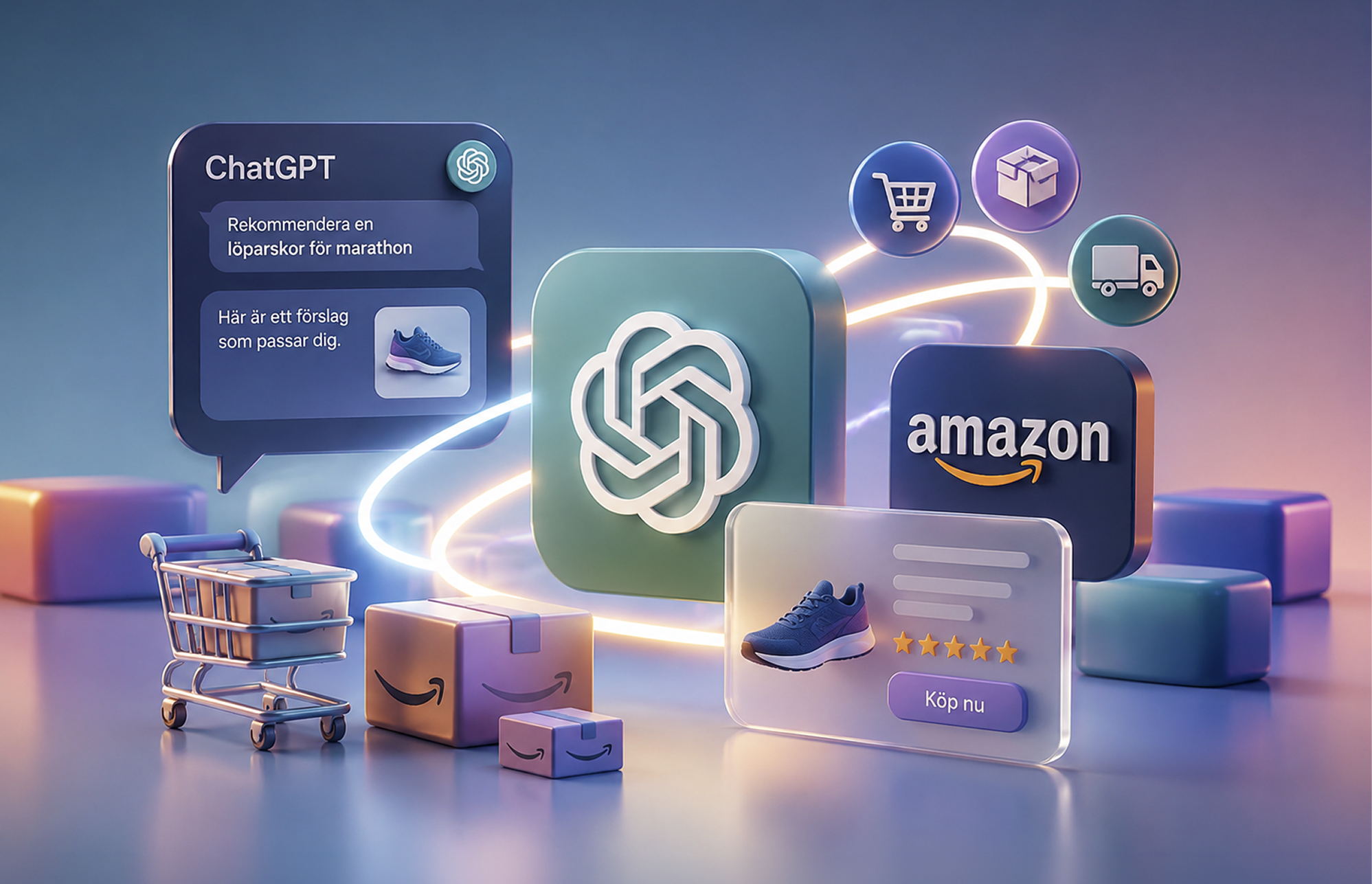
What does the Amazon partnership mean in practice?
The partnership is significant, but what does it mean in practice? This agreement directly affects where you need to be visible and how transactions in AI interfaces are likely to work. A lot is still moving. Some things are verified facts, others are the most likely direction of travel.
What we know: Amazon is investing up to 50 billion dollars in OpenAI and, in return, gets a central role in OpenAI’s cloud infrastructure. At the same time, Amazon is launching Shop Direct, a system that lets external merchants sync product data with Amazon’s AI services and reach customers through Amazon’s own buying journeys.
What is the likely direction: now that Instant Checkout has been shut down and Amazon is building transaction infrastructure for AI commerce, the most likely development is that future buying journeys in ChatGPT will connect to Amazon’s infrastructure rather than through direct integration with OpenAI. But this is not yet fully implemented.
What remains unclear: one central question still has no clear answer, and that is who owns the customer relationship when a purchase is initiated through Amazon’s infrastructure. For merchants that do not sell through Amazon, this creates a strategic question: do you want to give Amazon access to your catalogue and your customer data, and on what terms?
Serkan Selcuk, Product Owner at Viskan, clarifies: "Shop Direct is Amazon’s way of opening its AI ecosystem to external merchants, but on Amazon’s terms. It is its own ecosystem with its own rules, separate from the open standards Google is driving. That means an integration with Amazon does not automatically give you visibility in Google or Microsoft, and vice versa."
While the transaction questions are still unresolved, one thing is clear: ChatGPT’s role as a commerce channel has already changed. And that affects you as an e-commerce business today.
How are ChatGPT users searching for products today?
When Instant Checkout disappeared, ChatGPT’s role as a commerce channel changed. Here’s what the picture looks like today.
Discovery and information search: ChatGPT pulls web results through Bing’s index. When a user asks for product reviews, comparisons or buying advice, it is Bing’s search index that is used. Organic visibility in Bing, well-written product content and correctly structured data on your site are relevant factors for appearing in these answers. That is an important reason why Bing visibility should not be ignored in a ChatGPT presence strategy.
Transactions: purchases now happen primarily through the merchant’s own apps and sites, which ChatGPT directs the user to. What has changed is that AI now plays an active role in the discovery phase, but when it is time to buy, it happens on the merchant’s platform just as before.
What that means: ChatGPT’s most important role today is discovery and research. Being recommended in ChatGPT is valuable. Converting inside ChatGPT is a different challenge, and the market has now seen that it does not work in its current form. The primary goal is for ChatGPT to direct the user to your site, and for your site to convert.
Oskar Nilsson, Online Growth Specialist at Viskan, says: "ChatGPT is a traffic channel, not yet a buying channel. What determines whether you appear in ChatGPT recommendations is the same as what determines AI visibility more broadly: structured data, deep product content and site authority. Start there."
That is the picture of ChatGPT as it stands today. But that picture is not shaped only by OpenAI and Amazon. A third player is also actively influencing what is possible.
Microsoft’s position, and the conflict that could reshape AI-driven e-commerce
The partnership between OpenAI and Amazon directly challenges Microsoft’s position. Microsoft had long held an exclusive role as cloud provider for OpenAI’s models, a right that was partly loosened in October 2025 when OpenAI was restructured as a for-profit company. That opened the door to the Amazon deal.
Microsoft now argues that parts of the partnership breach the remaining exclusivity agreement. Financial Times reported on 18 March 2026 that Microsoft is considering legal action. Negotiations are ongoing, and no lawsuit has been filed.
It is a clear sign of how quickly the balance of power is shifting, and how uncertain it is what will apply tomorrow. If Microsoft escalates and succeeds in limiting what Amazon and OpenAI can do together, the entire architecture of ChatGPT’s commerce infrastructure could change again. And that brings us to the most important question: what do you do with all of this?
What does this mean for you as an e-commerce business?
What is playing out between Amazon, OpenAI and Microsoft can feel like a distant tech conflict. But the consequences land in your business: which channels you are visible in, where your customers find you, and how transactions in AI interfaces will work going forward.
There is one area where you can act now, regardless of how the conflicts play out: visibility in AI search. ChatGPT is already a traffic channel for product discovery, and what determines whether you appear there is structured product data, deep and conversational content, and a site that is seen as authoritative in its category. That work delivers impact across ChatGPT, Gemini and Perplexity at the same time, and it is not affected by shifts in the balance of power between the tech companies.
What is wise to hold off on, however, is locking yourself into a specific transaction ecosystem. As this article shows, the rules can be rewritten in ten days. Build a foundation that works regardless of who wins.
Want to see how Mímis creates product copy and web pages?
Get in touch with us at Viskan and see how you can make your e-commerce more efficient.
FAQ: Common questions about ChatGPT and Amazon
The article’s subject matter experts

Serkan Selcuk – Product Owner, Viskan
Serkan Selcuk is a Product Owner at Viskan with more than 17 years of experience in e-commerce solutions. He is an authority on developing scalable e-commerce platforms and strategic third-party integrations that meet modern B2B and B2C e-commerce needs. Serkan combines deep technical expertise with commercial understanding to help businesses optimise their e-commerce strategy and build future-proof solutions.
Serkan’s areas of expertise include:
- E-commerce platform strategy for growth
- Smooth integrations with ERP, PIM and logistics systems
- Development of scalable systems for high traffic
- Customer-centric solutions for the best possible user experience (UX)

Oskar Nilsson – Online Growth Specialist, Viskan
Oskar Nilsson is an Online Growth Specialist at Viskan with more than 10 years of experience in digital marketing. He specialises in organic visibility (SEO), Google Ads and driving effective traffic for e-commerce businesses. By implementing data-driven digital strategies, Oskar helps companies maximise digital growth and long-term value, with a focus on both paid and organic traffic. He has proven experience of successfully delivering digital migrations where digital visibility and traffic are maintained throughout the process.
Oskar’s areas of expertise include:
- SEO and optimisation for organic search
- Google Ads and performance marketing
- Digital migration for stability and retained visibility
- Data-driven growth strategy for e-commerce

Discover
Viskan Next Generation

Discover Mímis

The AI agent for smarter e-commerce
Read more
Viskan way of composable commerce
Sources
WIRED: Why Walmart and OpenAI Are Shaking Up Their Agentic Shopping Deal, 18 March 2026
Bain & Company: Agentic AI Commerce Hinges on Consumer Trust, 2026
GeekWire: How Amazon's $50B OpenAI deal actually works, 1 March 2026
Forrester: Power Couple OpenAI + Amazon May Have Just Won Consumer Agentic Commerce, March 2026