


Upptäck Mímis

AI-agent för smartare e-handel
The e-commerce buzzword list – how to prioritise correctly in the jungle
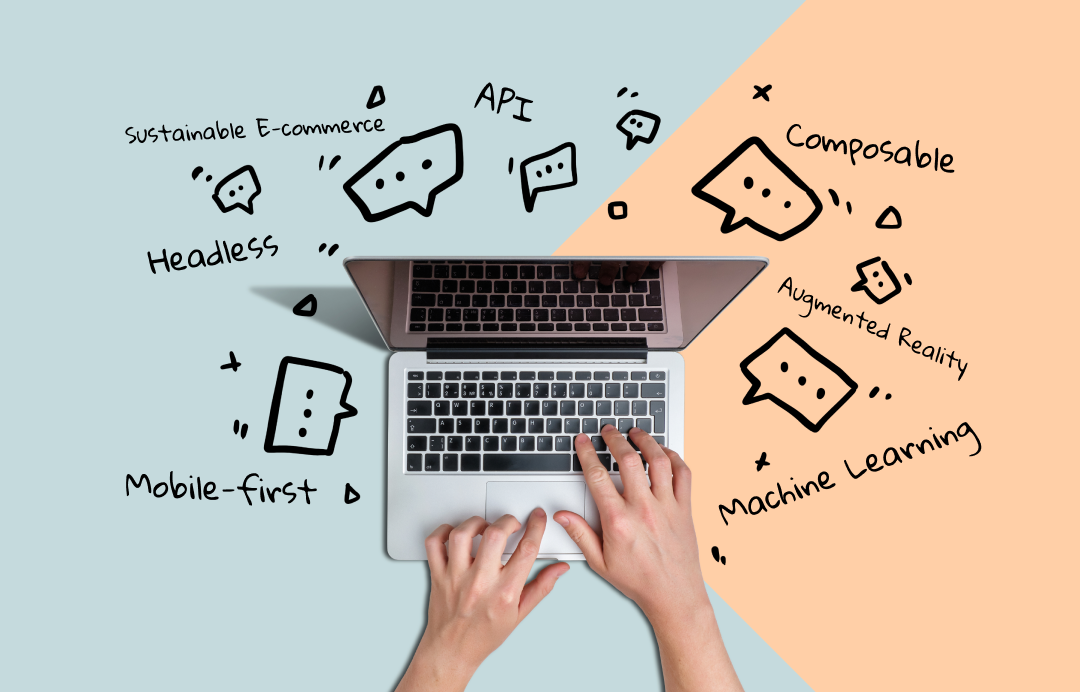
E-commerce is a constantly changing market where new technology and new customer behaviours continually bring new conditions. That is why new terms and concepts also keep appearing. As an e-retailer, you will constantly come across new technical terminology and trendy buzzwords. They are generally in English because the American market has such a strong influence through its leading role in e-commerce and tech. But what do API-first design, headless, AI for personalisation and other jargon you encounter in the industry actually mean?
To make informed decisions about what is right for your e-commerce business, while also identifying the trends that can give you competitive advantages, you need to understand what these concepts really mean and what functionality they bring. We have therefore compiled a buzzword list to help you understand what truly creates value for your e-commerce business.
What is headless commerce?
Headless means that the e-commerce solution has decoupled its frontend (the part customers interact with) from its backend (the part that you as an e-retailer manage, i.e. product, inventory and order management, deliveries, etc.). This provides a more flexible and customisable e-commerce setup compared with e-commerce platforms where everything in the architecture is connected (something that today is usually called a monolithic platform). This makes it easier for you as an e-retailer to develop and scale your e-commerce business as your needs and circumstances change, because you can quickly adapt your frontend to meet new trends and needs without having to change your backend.
While headless enables a smoother and more customisable e-commerce setup, there are however a few things you need to keep in mind when it comes to headless commerce:
- Even though non-headless is harder to scale and customise, it is usually easier to get started with. Especially if you are new to the industry, do not have any technical knowledge, but want to get to market quickly.
- Headless generally means that you work in several different systems, so you need to be more familiar with the different parts of your e-commerce business. Alternatively, get help from someone who has the expertise to run and develop a headless e-commerce platform.
What is composable commerce?
You may notice that headless is sometimes described synonymously with the term composable. But in reality, they differ to some extent. Both headless and composable are based on decoupling the platform, but composable goes a step further and is based on a more modular architecture where smaller independent functions and services are used to create tailored e-commerce solutions. You can read more about how composable commerce works in the article “Are you maximising the benefits of composable commerce for your e-commerce business?”.
What is API-first design?
APIs (Application Programming Interface) are not in themselves anything new. They have been used for decades to transfer data between different applications. But more as an add-on than as a cornerstone of the architecture. API-first is a methodology that means not only using APIs to allow the different parts of a headless or composable platform to communicate with each other. They are prioritised from the very beginning as a foundation when the architecture is developed, instead of being added afterwards.
Building an e-commerce solution API-first requires a little more time and planning, but the result brings many advantages. APIs are an important part of headless commerce because they make it easier for you as an e-retailer to develop your e-commerce business with new functionality. You get something of a plug-and-play architecture that is easy to scale and integrate with new systems and services. There may be more to keep track of, but with API-first you can adapt your platform more quickly to benefit from new technology and new trends. In this way, a better user experience is also created.
What is mobile-first design?
Mobile-first is about meeting customers where they are and giving them a smooth shopping experience on the device they prefer. According to a report from Statista, mobile e-commerce is growing strongly and in 2023 it accounted for 60% of all e-commerce. An online shop designed mobile-first means that it has been developed from the outset for smaller mobile screens. This differs from the traditional way of first designing it for larger computer screens and then adapting it for mobile devices. Mobile-first is a development based on the fact that more and more people use their mobile to shop online. At Viskan, we have been able to measure that as much as 80–90% of our customers’ visitors are mobile users. The exception is companies that sell B2B and usually have a lower share of mobile users.
Augmented Reality Shopping Experiences
Augmented Reality (AR) is a technology that combines the real world with digital information by placing digital objects in real spaces. For example, a digital fitting room where the customer can try products such as clothes or glasses by having them placed digitally over an image of the customer. AR combines the physical shops’ ability to offer personal customisation with the convenience of e-commerce. It provides a more interactive and engaging experience that bridges the possibilities of digital and physical retail, making the buying experience more adaptable and personal. Not least, it allows customers to make more informed purchasing decisions, which in turn leads to increased customer satisfaction and fewer returns.
Sustainable E-commerce Solutions
While e-commerce appeals to customers because of its convenience, more and more customers are placing demands on the environmental impact of e-commerce. For example, in the form of transport, carbon emissions and packaging waste. Sustainable e-commerce is based on reducing environmental impact by using strategies to inform customers about environmental impact, reduce packaging materials, optimise transport, etc. This can be done in several ways. For example, by declaring climate and environmental impact in the product information, offering customers environmentally friendly options for both products and deliveries, or giving them the opportunity to offset their carbon emissions at checkout.
Artificial Intelligence and Machine Learning for Personalization
With the help of customer data, it is possible to predict which product a customer is most likely to want to buy based on previous purchases and behaviours, demographic data and other data. This provides a personalised experience that is more relevant to the customer’s needs and tastes. AI and machine learning are powerful tools for quickly collecting and analysing large amounts of data. They also allow you as an e-retailer to gain deeper insights that enable you to create more accurate personalised customer journeys. With AI-driven recommendations that fit well with a customer’s current purchase, it is possible to increase upselling while also improving the customer experience.
In addition to AI being able to offer more personalised customer experiences, AI also has the potential to streamline the translation process when it comes to website languages. Not only can AI help improve the quality of translations and thereby enable faster and more cost-effective launches in new markets for e-retailers looking to expand globally. AI can also personalise content for different languages and regions, giving each visitor a more relevant and engaging experience.
Focus on value, not on what is popular
There are many opportunities behind all the buzzwords. But that does not mean they are automatically good for all e-retailers. If you want a flexible and modular solution with major development possibilities, API-first is a good choice, but perhaps not if you want to avoid a platform with high complexity. Augmented Reality can enhance the customer experience if your e-commerce business is based on products that your customers want to try first, but probably not if you sell software solutions. The risk with trendy concepts is that it is easy to jump on them because they sound popular, even if you do not actually have any business need for them. What adds value to your e-commerce business depends on everything from product type and target audience to transaction volumes and which channels you use. Therefore, always start with your strategies and business needs so that you can choose what is best for your e-commerce business and for your customers.
At Viskan, we would rather talk about which functions suit your e-commerce business than about what is trendy right now. We want to be a partner that explains and guides. With us, you get a dedicated contact person who clarifies the concepts, listens to your plans and needs, understands your business idea and guides you in the right direction in line with your goals. Talk to us at Viskan so you do not have to be confused by all the buzzwords and can get the functions you really need!
Ready to take the next step?
Get in touch and we'll show you how Viskan can accelerate your e-commerce.