


Upptäck Mímis

AI-agent för smartare e-handel
Published 2026-10-27
WebMCP in Viskan Next Generation: Ready for agentic commerce
AI assistants are learning how to shop. Soon, your customer will be able to ask ChatGPT or Gemini to find blue hiking trousers in size 52 and add them to the basket. At that point, it’s not enough for the assistant to read your store. It has to be able to use it. Viskan Next Generation now supports WebMCP, the technology from Google and Microsoft that makes it possible for AI agents to act in your store. The standard is not finished yet. But your store in Viskan Next Generation is already ready.
In brief:
WebMCP is a new web API from Google and Microsoft that lets a website tell AI agents exactly what they’re allowed to do on the page. The standard is not yet finalised, but Viskan has already built support into the Next Generation e-commerce platform, with six tools: product search, product details, get basket, add to basket, update line item and discount code. Every agent call goes through the same code as a visitor click, with the same stock checks, pricing rules and tracking. Checkout and payment are excluded, since agent-initiated payments still lack established solutions for authentication and liability.
What are agentic commerce and WebMCP?
Agentic commerce is when an AI agent shops on behalf of a person: searching for products, comparing options and adding items to the basket. One piece has been missing. An online store is built for people who can see and click, so today an agent has to interpret the page from the outside, read the code and guess what each button does. As soon as something changes, it loses its way.
WebMCP fixes that. It is a new web API, driven by Google and Microsoft, where the website itself tells the agent what it is allowed to do and which inputs are required. Search products, provide a search term. Add to basket, provide variant and quantity. The agent no longer has to guess.
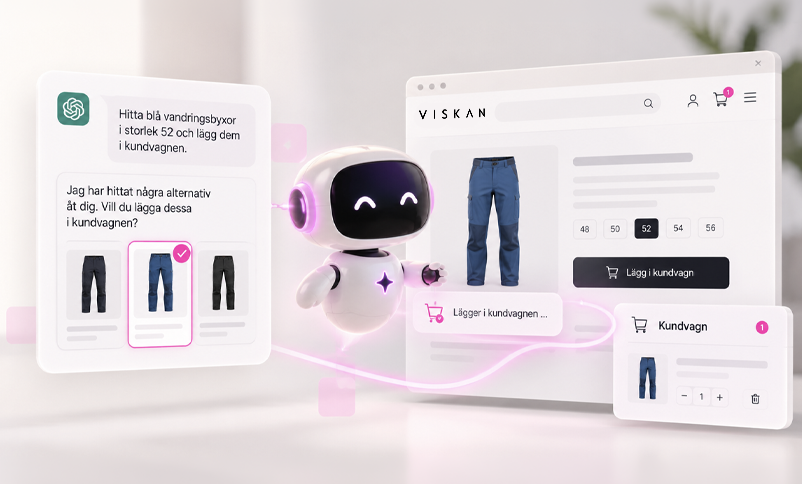
What an AI agent can do in Viskan Next Generation
Viskan Next Generation has six WebMCP tools in place. Together, they cover the full journey from question to completed basket.
Product search.
The agent searches your assortment using free text, by product name, brand, category or keyword. It gets back matches with price, stock status and a link to the product page.
Product details.
For an individual product, the agent retrieves the description, size and colour variants, prices and stock status per variant.
Get basket.
The agent reads the basket as it stands: line items, quantities, prices, fees, discounts, total and any discount code.
Add to basket.
The agent adds a specific variant and gets the updated basket back.
Update line item.
The agent adjusts the quantity on an existing line item or removes it.
Discount code.
The agent adds or removes a discount code.
Each tool has its own rules for what the agent must provide in order to use it. The agent cannot ask for anything it likes and hope for the best. It has to supply the inputs the tool requires. The tools are also chained together: the search returns the product number, the product number returns the variant identifier, and only that identifier works with the basket. The agent cannot invent an item number on its own and end up with the wrong size.
Structured data helps the agent find. WebMCP lets it act.
For an AI agent to shop in an online store, two layers need to be in place. Viskan Next Generation delivers both.
Structured data helps AI agents find your products. It tells them what a product page contains: which product, which variants, which prices, what is in stock. Next Generation generates it automatically.
WebMCP takes over where description alone is not enough and lets the agent act:
- Query the assortment. The agent searches the full catalogue on the customer’s behalf, instead of reading one page at a time.
- Get real-time answers. Stock levels and prices are fetched the moment the agent asks, for the exact size and colour the customer wants.
- Carry out actions. The agent adds the right variant to the basket, changes quantities and applies a discount code, using the store’s own functions.
One does not replace the other. Structured data determines whether the agent finds your store. WebMCP determines what it can do once it gets there.
How agent calls follow the same path as a click in the store
The basic principle behind reliable agent support is that the agent must not get its own separate route into the store. If it does, you create a second channel with its own prices, its own stock levels and its own logic, and someone then has to keep that in sync with the real store.
In Next Generation, the agent’s calls go through the store’s existing functions, and an agent instruction to add something to the basket follows exactly the same path as a visitor click.
Four concrete consequences:
- Stock levels and pricing rules apply. The agent cannot add an out-of-stock size to the basket or bypass campaign pricing.
- Tracking records it. When the agent adds an item to the basket, it appears in your analytics just as it does when a visitor does it.
- Market, language and currency carry through, including agreed prices for a logged-in customer.
- The agent’s basket is the store’s basket. What the agent adds to the basket is visible in the store interface.
Andreas Strandman, System Architect at Viskan, says: “Each WebMCP tool in Next Generation has rules for exactly what the AI agent must provide, for example which variant and how many when adding an item to the basket. These are the same rules the platform validates the call against. What the agent is told is always what actually applies, and it never has to guess.”
The agent fills the basket. The customer pays.
In Viskan Next Generation, the agent takes the customer all the way to checkout, and hands over there. Checkout, payment and personal data are handled by the customer themselves, and that is how it needs to work today. The EU payments framework is built on the cardholder approving the purchase themselves, and for payments initiated by an agent there are still no established solutions.
That line is also where customers themselves want it drawn. Swedish consumers want AI to help them find and compare, but they want the final say themselves, according to E-barometern Q1 2026 from PostNord and HUI Research.
One practical detail: the stock levels and prices the agent retrieves are point-in-time readings, not reservations. The same applies to a visitor who adds something to the basket and then waits.
"The agent takes the customer all the way to checkout. Payment, approval and authentication stay with the human, because that’s where regulation draws the line and where customers want to stay in control. That’s not a limitation in the platform. Once regulation and liability are clarified, the rest of the journey is already in place in Next Generation", says Serkan Selcuk, Product Owner at Viskan.
Why is Viskan building support before the market asks for it?
In the US, the curve has already turned. Visitors arriving at US retail sites via AI services converted 54 per cent better than other traffic in May 2026 and generated 53 per cent more revenue per visit. Twelve months earlier, other traffic was worth 128 per cent more. Traffic from AI services grew by 138 per cent compared with the previous year, and since Adobe started measuring in October 2024, it has grown by 1,324 per cent. The figures come from Adobe Digital Insights’ Q3 AI Traffic Trends report, published in June 2026.
The Nordics are behind, but the shift is moving quickly. More than two in five Swedish consumers use AI regularly, but only one in ten used AI in their most recent online purchase. At the same time, Adyen’s survey of 2,000 Swedish consumers shows that 29 per cent have already used AI assistants in connection with shopping, and 41 per cent are open to letting AI handle the entire buying journey.
So the behaviour is already there. What is missing is the connection between the assistant and the store, and Google, Microsoft and OpenAI are building that right now. Once it is in place, it will quickly become clear which stores an agent can work in and which ones it skips. If an agent cannot find your blue hiking trousers, or finds them but cannot check size 52 and add them to the basket, it moves on to a store where it can. That sale never happens, and you will rarely know why.
That is why you should have the foundations in place while agents are still learning the route, not when they start shopping.
Kristian Iveling, CEO of Viskan, predicts: "Waiting until customers ask for something is a reliable way to stay behind. When agentic commerce takes off, it will move fast, and by then it’s too late to start building. I may be wrong about the timing. I’m not wrong about the direction, and that’s why we’re taking this cost now instead of forcing our customers to take it under pressure."
Where WebMCP stands today, and how Viskan Next Generation is prepared
WebMCP is not yet a finished standard. It is being developed within the W3C’s Web Machine Learning Community Group, with Google and Microsoft driving it, and Google published the documentation and launched a public test programme for Chrome in May 2026, while Microsoft is running a similar programme for Edge. Agents are starting to connect. OpenAI has added support for the technology in ChatGPT, and Gemini in Chrome is the agent Google is building for it, so far outside the EU. The specification is still changing.
In Viskan Next Generation, support is ready for all browsers that support WebMCP. In browsers that do not yet support it, visitors will notice no difference.
If you use Viskan Next Generation, the support is already in the platform, and Viskan activates it for your store, including registration in the browsers’ test programmes. When agents start shopping, your store will already be prepared.
Frequently asked questions about WebMCP and agentic shopping
Article subject matter experts

Andreas Strandman - System Architect, Viskan
Andreas Strandman is a System Architect at Viskan with more than 12 years’ experience developing e-commerce platforms. He specialises in bringing frontend and backend together into powerful, high-performance web applications. With many years of experience in web development, Andreas combines deep technical expertise with the ability to see the bigger picture and the connections between different parts of a system. He is a key contributor to Viskan Next Generation and ensures the platform’s CMS solution stays top class.
Andreas’s areas of expertise include:
- System architecture for scalable e-commerce platforms
- CMS development focused on performance and user experience
- Technology choices and implementation for modern web applications
- A holistic view of platform, backend and frontend

Kristian Iveling – CEO, Viskan
Kristian Iveling is CEO of Viskan and has more than 20 years’ experience in e-commerce systems and strategic business development. Since taking on the CEO role in 2019, he has led Viskan’s technical development with a focus on building efficient ecosystems that strengthen customers’ competitiveness. Kristian combines technical innovation with deep commercial understanding to drive sustainable growth, both for Viskan and for companies that choose the Viskan E-commerce platform.
Kristian’s areas of expertise include:
- Strategic business development for technology-driven companies
- Technical innovation in e-commerce
- Building e-commerce platforms for scalability and efficiency
- Leadership in technology and product development

Serkan Selcuk – Product Owner, Viskan
Serkan Selcuk is a Product Owner at Viskan with more than 17 years’ experience in e-commerce solutions. He is an authority on developing scalable e-commerce platforms and strategic third-party integrations that meet modern B2B and B2C e-commerce needs. Serkan combines deep technical expertise with commercial understanding to help companies optimise their e-commerce strategy and build future-proof solutions.
Serkan’s areas of expertise include:
- E-commerce platform strategy for growth
- Smooth integrations with ERP, PIM and logistics systems
- Development of scalable systems for high traffic volumes
- Customer-centric solutions for the best possible user experience (UX)

Discover
Viskan Next Generation

Discover mimis

The AI agent for smarter e-commerce

Read more
Agentic Commerce
The shift changing e-commerce.